You know, I’ve been running around construction sites all year, and honestly, everyone's talking about prefabrication now. Not just simple stuff, but really getting into complex assemblies, even whole modules. It's supposed to be faster, cheaper… easier. Easier is a funny word in this business, though.
Have you noticed how everyone's chasing this “lean construction” thing? Sounds great in a boardroom, but on the ground, it usually means someone’s trying to cut corners. And those corners always come back to bite you. I encountered this at a steel factory last time, they were using thinner gauge steel than specified. Saved them a few pennies per ton, but the welders were having a nightmare, and the structural integrity… well, let’s just say I had a long conversation with the quality control manager.
Speaking of materials, we're using a lot of high-strength steel, obviously. The S355 and S460 grades are pretty standard now. Feels different under the crane, heavier, more… substantial. And the new composite panels – you can smell the resin when you cut them, kinda sweet and acrid. Takes getting used to. We've also been experimenting with more recycled plastics in non-structural elements. It’s good, but the consistency can be… suspect. You get a bad batch, and suddenly your tolerances are way off.
Introduction to Pile and Ground Beam Foundations
Pile and ground beam foundations, they're the unsung heroes of a lot of construction projects. You don't see them, but without them, everything falls apart. Literally. We're talking about transferring loads from structures – buildings, bridges, you name it – through weak or unstable soil layers down to stronger, more competent strata.
It’s not glamorous work, but it’s essential. It's especially critical in areas with poor soil conditions, high water tables, or where you're building on sloping ground. It’s becoming more and more important as we build bigger, taller, and more complex structures in increasingly challenging environments. I mean, look at what’s happening in coastal cities – sea levels rising, soil erosion… you need a solid foundation, or it’s all coming down.
Strangely, a lot of younger engineers seem to think it’s all about fancy software and calculations. Don't get me wrong, the modelling is important, but nothing beats real-world experience. Knowing how the soil feels when you’re driving a pile, knowing when something just doesn’t look right… that’s what keeps things from going sideways.
Global Relevance and Challenges
Pile and ground beam foundations are relevant everywhere. From the skyscrapers of Dubai to the infrastructure projects in developing nations, they are a fundamental part of construction. The UN estimates that over half the world’s population lives in urban areas, and that number is only going to increase. That means more building, more infrastructure, and therefore more demand for reliable foundation solutions. The World Bank is investing heavily in infrastructure projects in developing countries, many of which require specialized foundation techniques.
But it's not without its challenges. Cost is a big one, obviously. Piling can be expensive, especially for deep foundations. There's also the environmental impact. Pile driving creates noise and vibration, which can disturb local ecosystems. And the disposal of spoil from drilling can be a problem. We're also seeing an increasing need for foundations that can withstand extreme weather events, like hurricanes and earthquakes.
And then there’s the skills gap. There’s a shortage of experienced pile drivers and foundation engineers. A lot of the knowledge is held by a shrinking number of older workers, and it's not being passed down effectively. Anyway, I think finding qualified personnel is going to be a major bottleneck in the years to come.
Defining Pile and Ground Beam Foundations
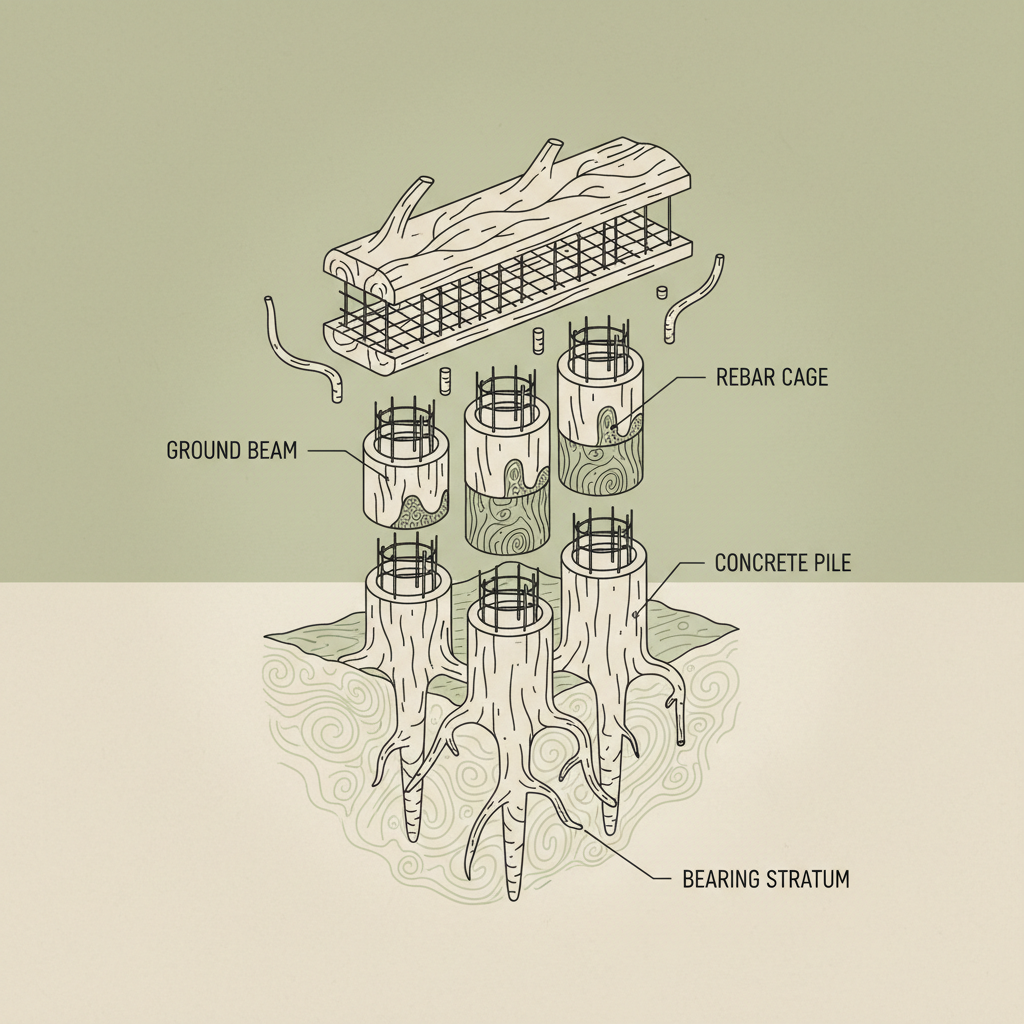
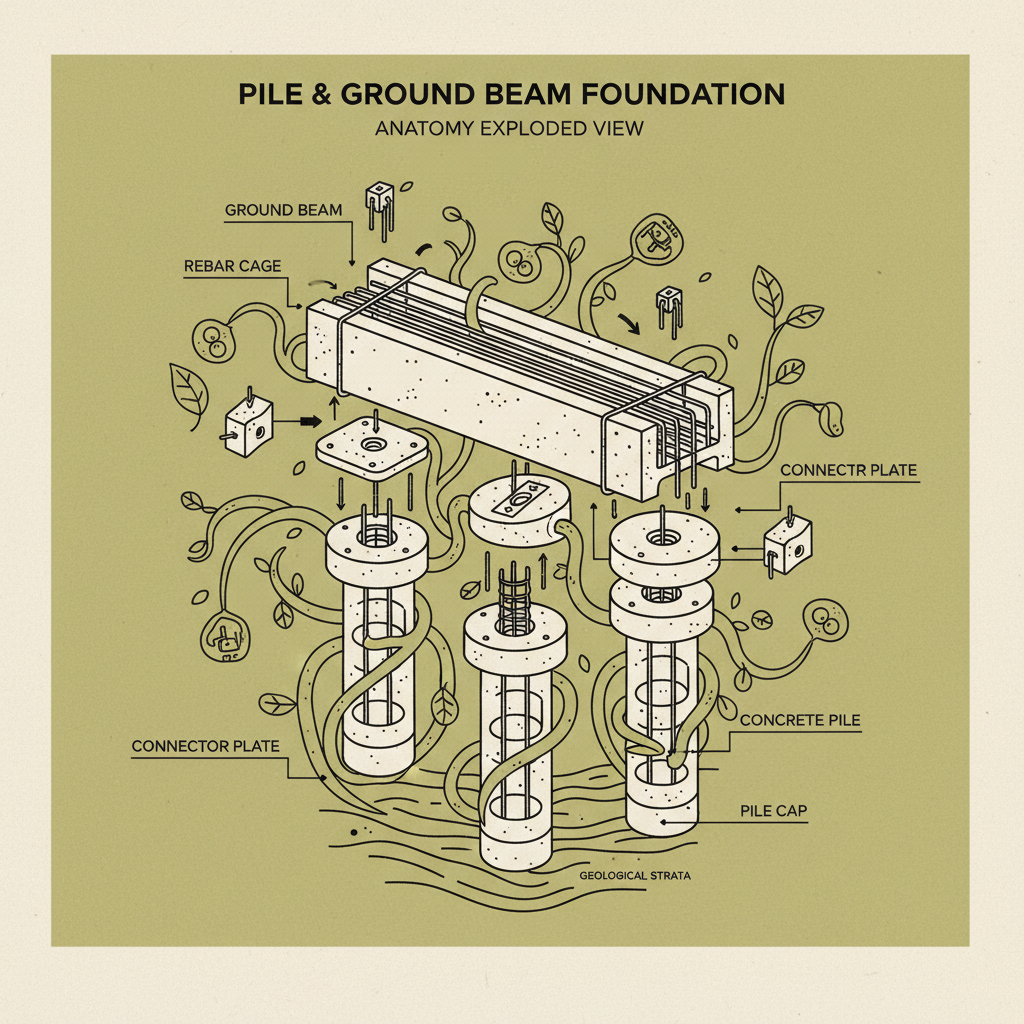
Okay, so what are we talking about? Simply put, a pile and ground beam foundation is a type of deep foundation used to transfer building loads to deeper, more stable soil strata. Piles are long, slender structural members – usually made of steel, concrete, or timber – that are driven or drilled into the ground. They act like columns, supporting the weight of the structure above.
Ground beams are horizontal structural members that connect the piles together. They distribute the load evenly across the piles and provide a platform for the superstructure. Think of it like a table – the piles are the legs, and the ground beam is the tabletop. It all needs to work in harmony. It connects directly to modern infrastructure needs, providing stable support for everything from high-rise buildings to transportation networks.
It’s all about soil mechanics. If the surface soil isn't strong enough to support the load, you go deeper until you find something that is. It's a pretty straightforward concept, but the execution can be incredibly complex.
Key Factors in Pile and Ground Beam Foundation Design
There are several crucial factors to consider when designing a pile and ground beam foundation. First, you’ve got soil conditions. You need to know the soil type, its bearing capacity, and its susceptibility to settlement. Thorough geotechnical investigation is non-negotiable. Then there’s load capacity. You need to accurately determine the loads that the foundation will be subjected to, including dead loads, live loads, and wind loads.
Another important factor is pile type. There are several different types of piles available, each with its own advantages and disadvantages. Driven piles are relatively quick to install, but they can create a lot of noise and vibration. Bored piles are quieter, but they can be more expensive. Durability is paramount. You need to ensure that the piles and ground beams are resistant to corrosion and other forms of degradation. Settlement control is critical, especially for sensitive structures. And finally, cost-effectiveness. You need to find a solution that meets your performance requirements without breaking the bank.
Pile and Ground Beam Foundation Method Comparison
Global Applications and Use Cases
You see pile and ground beam foundations everywhere. In post-disaster relief operations, they’re used to create stable foundations for temporary shelters and hospitals. In remote industrial zones, they support heavy machinery and infrastructure. I saw a project in the Arctic last year where they were building a research station on permafrost – that was a challenging one!
They’re critical for bridge construction, especially over waterways or unstable ground. Think of the Golden Gate Bridge, the Brooklyn Bridge – those wouldn't be standing without deep foundations. They’re also used extensively in high-rise building construction, particularly in cities with poor soil conditions like Tokyo and Dubai. And lately, we've been seeing a lot of them used in wind turbine foundations, both onshore and offshore.
Advantages and Long-Term Value
The biggest advantage, hands down, is stability. Pile and ground beam foundations provide a reliable and long-lasting support system for structures. They can withstand heavy loads, resist settlement, and protect against the effects of soil erosion and seismic activity. They also offer versatility – they can be adapted to a wide range of soil conditions and loading requirements.
There’s a long-term cost benefit too. Sure, the initial investment is higher, but a well-designed and properly installed foundation will last for decades, minimizing the need for costly repairs or replacements. It’s about building something that’s going to stay built. And that gives you peace of mind, and that’s priceless.
Future Trends and Innovations
We’re seeing a lot of innovation in this field. There's a push for more sustainable materials, like using recycled plastics and bio-based polymers in pile construction. Digital twins are also becoming more common – creating virtual models of the foundation to monitor its performance and predict potential problems.
Automation is also starting to play a role. Robotic pile drivers and automated drilling rigs are becoming more sophisticated, increasing efficiency and reducing labor costs. And there's a lot of research going into new foundation techniques, like using ground improvement technologies to strengthen the soil before piling. It’s a constantly evolving field, that’s for sure.
Summary of Key Challenges and Solutions in Pile and Ground Beam Foundation Application
| Challenge |
Impact on Project |
Potential Solution |
Implementation Cost (Scale 1-10) |
| Unforeseen Soil Conditions |
Project delays and cost overruns |
Enhanced geotechnical investigation, contingency planning |
6 |
| Noise and Vibration during Piling |
Disturbance to surrounding communities, potential damage to nearby structures |
Use of noise barriers, vibration damping techniques, alternative foundation methods |
7 |
| Material Supply Chain Disruptions |
Delays in project completion, increased material costs |
Diversification of suppliers, long-term contracts, strategic stockpiling |
5 |
| Skilled Labor Shortage |
Reduced productivity, increased risk of errors |
Investment in training programs, apprenticeship schemes, automation |
8 |
| Environmental Regulations |
Increased compliance costs, project delays |
Adoption of sustainable materials, waste management strategies, environmentally friendly techniques |
4 |
| Difficult Site Access |
Increased logistical challenges, higher transportation costs |
Careful planning, use of specialized equipment, modular construction techniques |
7 |
FAQS
A well-designed and properly constructed pile and ground beam foundation can easily last 75 to 100 years, or even longer. The lifespan depends heavily on the materials used, the soil conditions, and the environmental factors. Regular inspections and maintenance can help extend its life. We've seen some foundations from the early 20th century still going strong, but they required significant rehabilitation work. It's not a 'set it and forget it' kind of thing.
Soil type is everything. Sandy soils are good for friction piles, where the weight of the structure is supported by friction between the pile and the surrounding soil. Clay soils are better suited for end-bearing piles, which transfer the load to a firm stratum below the clay. Rocky soils require specialized drilling techniques. You also need to consider groundwater levels, soil permeability, and the potential for soil liquefaction during earthquakes. It's complicated, to say the least.
There are a few common culprits. Underestimation of loads, inadequate geotechnical investigation, corrosion of steel piles, and settlement due to poor soil compaction are all potential problems. Sometimes, it's just poor workmanship – piles not driven to the correct depth, or improper connections between piles and ground beams. Regular monitoring and maintenance can help identify and address these issues before they become critical.
Yes, it is possible, but it's usually expensive and complex. One option is to add additional piles alongside the existing ones. Another is to use ground improvement techniques to strengthen the surrounding soil. You can also install a reinforced concrete cap over the existing piles to distribute the load more evenly. The feasibility depends on the existing foundation design and the available space.
Noise and vibration pollution are major concerns, especially in urban areas. Soil erosion and water contamination are also potential problems. We try to minimize these impacts by using quieter piling techniques, implementing erosion control measures, and carefully managing waste disposal. Using recycled materials whenever possible is also a good practice. We have to work with the local environmental regulations.
That's a loaded question! Costs vary wildly depending on the soil conditions, pile type, foundation depth, and location. A small residential project might cost a few thousand dollars, while a large commercial project could easily exceed millions. It's usually around 10-20% of the total building cost, but it can be higher in challenging ground conditions. Getting accurate quotes from qualified contractors is essential.
Conclusion
So, pile and ground beam foundations: they’re not glamorous, they’re often hidden, but they are absolutely critical to the stability and longevity of countless structures. From dealing with challenging soil conditions to weathering the test of time, these foundations embody resilience and reliability. They’re evolving with new materials and techniques, but the fundamental principles remain the same.
Ultimately, whether this thing works or not, the worker will know the moment he tightens the screw. You can run all the simulations you want, you can use the fanciest software, but at the end of the day, it's about practical experience, attention to detail, and a healthy dose of common sense. And honestly, after all these years, that’s what I’ve learned. You can find us at pile and ground beam foundation.